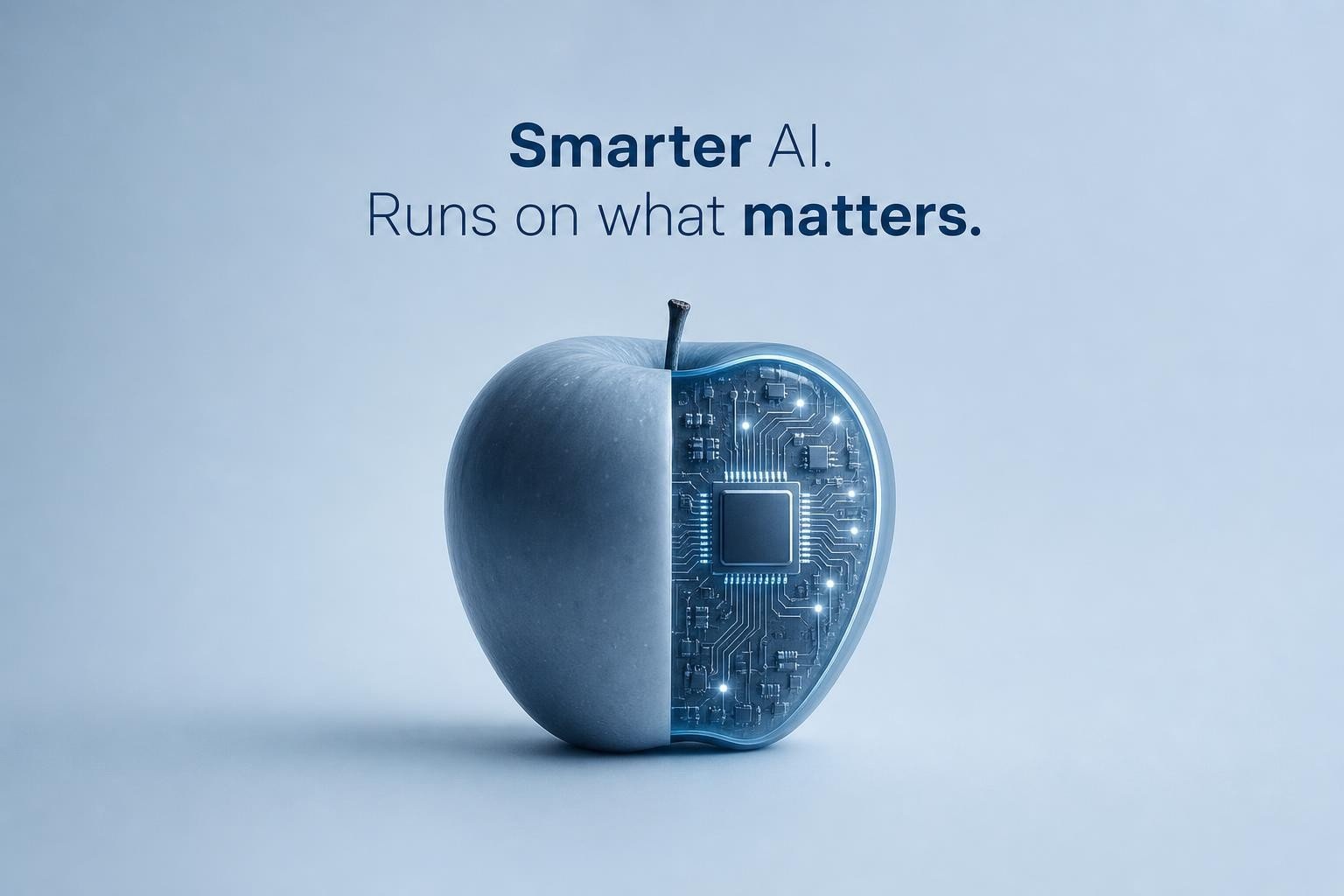
Apple’s open-weight AI work has prompted an attention-grabbing question: could smaller models running on devices make today’s data centers obsolete, and are they better than GPTs?
The evidence does not support either conclusion. Apple’s OpenELM family is important because it demonstrates how capable language models can be designed for more efficient local deployment. But it is not a direct replacement for the largest cloud models, and its existence is unlikely to eliminate demand for data centers.
The more credible outcome is a shift in how AI workloads are divided between devices and the cloud.
What Apple actually released
Apple published the OpenELM research and model family as an open-weight language-model project. Open weights allow developers and researchers to inspect, download and adapt model parameters under the relevant license terms. That is different from simply offering access to an AI system through an application programming interface.
OpenELM models are relatively small compared with the largest commercial systems. Their practical appeal is local inference: a model can potentially run on a phone, laptop or other edge device with less dependence on a remote server.
That design fits Apple’s hardware strategy. On-device processing can reduce latency, improve privacy and keep some tasks available when connectivity is limited. It can also lower the cost of sending every user request to a centralized service.
Why data centers are not going away
Efficient edge models may reduce demand for some cloud inference, but they do not remove the need for data-center capacity.
Training advanced models requires substantial computing resources, storage, networking and electricity. Cloud systems also remain better suited to workloads that require larger context windows, broad tool access, complex reasoning, frequent model updates or coordination across multiple services.
Even when a small model runs locally, companies still need infrastructure for model training, software distribution, telemetry where users permit it, security updates and larger tasks that devices cannot handle efficiently. The likely effect is workload migration rather than infrastructure extinction.
There is also a commercial distinction between consumer inference and enterprise AI. A smartphone assistant may answer a short question locally, while a bank, manufacturer or global retailer may need centralized controls, auditability, data integration and predictable service levels. Those requirements continue to favor cloud and private data-center deployments.
Is Apple’s model better than GPT?
“Better” depends on the job. OpenELM should not be treated as a universal competitor to the most capable GPT systems. The models differ in scale, training approach, access model, tool integration, evaluation methods and intended use.
A larger hosted model may deliver stronger performance on difficult reasoning, long documents, coding or multimodal tasks. A small open-weight model may be preferable when cost, privacy, offline access, customization or response speed matters more than maximum capability.
There is another source of confusion: GPT models and custom GPTs are not identical concepts. A GPT can refer to a model family, while a custom GPT is a configured assistant built within a platform. Comparing Apple’s downloadable model weights with a customized hosted assistant is therefore not an apples-to-apples benchmark.
Developers who want to test Apple’s model can review the available materials and model files on Apple’s Hugging Face organization. Any comparison should use the same task, prompt, hardware, latency target and cost assumptions. General claims based on a single benchmark are unlikely to guide a real deployment decision.
The strategic significance for Apple
Apple’s open-weight research matters less as a threat to data centers than as a signal about the future of personal computing. If useful AI features can run locally, device makers gain more control over privacy, responsiveness and operating costs.
That could pressure cloud providers in selected categories, especially short, repetitive interactions. It may also encourage a hybrid architecture in which a device handles routine requests and escalates complex work to a remote model.
For Apple, the approach can support a broader ecosystem strategy. Local models are easier to align with the company’s emphasis on hardware and integrated software, although real-world performance will depend on memory, battery consumption, model compression and the quality of the surrounding operating-system features.
The likely market outcome
The AI market is moving toward a layered model. Small systems will handle more requests at the edge, while larger systems will continue to serve demanding applications from centralized infrastructure. Businesses will choose between them according to economics, privacy requirements and performance.
Apple’s open-weight models could help make local AI more credible and accessible. They do not, on the available evidence, make GPT systems obsolete or threaten to “kill” data centers. Their real impact may be quieter: fewer routine requests reaching the cloud, more experimentation by developers and a stronger negotiating position for companies that want AI without sending every piece of data to an external server.
For more coverage of AI infrastructure and emerging technology, visit the Innovation and Technology section.